If you haven't read a short story recently, it is worth a look.
July 8, 2009
Read a Short Story This Summer
Looking to get in some summer reading, but don't want to read a novel? Or, do you just read novels and haven't read any short stories recently? Book publisher Harper Perennial has created Fifty-Two Stories, a blog that posts a complete short story each week. Most are new. However several classics will also be posted. Authors include Dennis Cooper, Alex Burrett, Mark Twain, Oscar Wilde and more.


July 7, 2009
Federal Websites Knocked Out by Cyber Attack
A widespread and unusually resilient computer attack that began July 4 knocked out the websites of several government agencies, including some that are responsible for fighting cyber crime, The Associated Press has reported.
The Treasury Department, Secret Service, Federal Trade Commission and Transportation Department sites were all down at varying points over the holiday weekend and into this week, according to officials inside and outside the government. Some of the sites were still experiencing problems on the evening of July 7.
Federal government officials refused to publicly discuss any details of the cyber attack, and would only generally acknowledge that it occurred. It was not clear whether other government sites also were attacked.
Others familiar with the outage, which is called a denial of service attack, said that the fact that the government sites were still being affected three days after it began signaled an unusually lengthy and sophisticated attack.
Read the entire article at Yahoo! Finance.
The Treasury Department, Secret Service, Federal Trade Commission and Transportation Department sites were all down at varying points over the holiday weekend and into this week, according to officials inside and outside the government. Some of the sites were still experiencing problems on the evening of July 7.
Federal government officials refused to publicly discuss any details of the cyber attack, and would only generally acknowledge that it occurred. It was not clear whether other government sites also were attacked.
Others familiar with the outage, which is called a denial of service attack, said that the fact that the government sites were still being affected three days after it began signaled an unusually lengthy and sophisticated attack.
Read the entire article at Yahoo! Finance.
Do You Poken?
With all the social networking sites available these days (Facebook, Myspace, Linkedin - oh my!) it can be hard to keep track of all your user information -- and tricky to exchange information with new contacts.
What happens when you attend a conference and meet new people face-to-face? Gone are the days of giving out phone numbers or email addresses via tiny business cards that can only hold so much information. Time to start poken!
What happens when you attend a conference and meet new people face-to-face? Gone are the days of giving out phone numbers or email addresses via tiny business cards that can only hold so much information. Time to start poken!

If you're not quite ready to take the poken plunge, Moo Cards are a slightly less expensive option. Design your own business cards and Moo Cards will print them and send them to you.
Some companies, such as VistaPrint, offer free business cards (you pay for shipping) but they will include their logo on the back of the card. Remember, when designing your business cards, the info side of your business card does not have to be the "standard" name, position, company, etc. You can share any information you want, including your social networking sites and usernames.
Some companies, such as VistaPrint, offer free business cards (you pay for shipping) but they will include their logo on the back of the card. Remember, when designing your business cards, the info side of your business card does not have to be the "standard" name, position, company, etc. You can share any information you want, including your social networking sites and usernames.
July 6, 2009
Microsoft Hohm: Saving Energy and Money

The site provides tips such as how to set up your thermostat, how to seal your home with weather-stripping, and how to replace the filter in your furnace.
From the Microsoft Hohm blog:
"Microsoft Hohm is a free online beta application that helps you save energy and money. With Microsoft Hohm you can better understand your home energy usage, get recommendations to conserve energy and start saving. As with any recommendation engine, Hohm will provide increasingly more accurate and relevant suggestions for energy conservation as its users contribute home energy input and feedback. One of the objectives during our beta period is to refine our tool and further increase the value our product can offer to you."
You can sign up or read more at Microsoft Hohm.
July 2, 2009
Happy Birthday to… Us!
A year ago, after discussing it for several months within the Library’s Technology Department, we started this blog. In our first post, Welcome to The Tech Desk, I wrote that we had two reasons for this project.
First, we wanted to continue the discussion we have with our public around technology issues. We wanted to share new websites and tools, improve our skills, and create a searchable body of knowledge useful for both Library staff and our users.
Second, we wanted to play with Web 2.0 technology. We had just begun a website redesign – a design of which we are in the final steps – and wanted to explore content management: allowing and encouraging all staff members to contribute to the content on our website. We believed, and still do, that such a site will be more user-friendly for our public and staff.
After a year, I would evaluate our progress as a success.
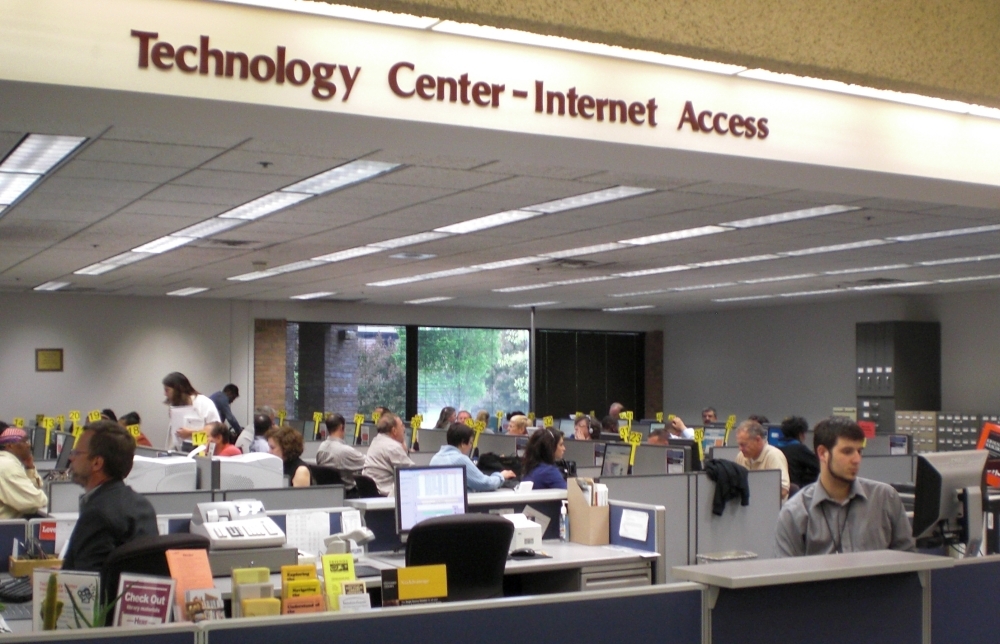 In terms of content, we have posted 556 stories, an average of nearly two per day. At the beginning, I set a goal of 20 stories a month: one per full-time staff per week, and one per part-time staff per month. But many staff members discovered that the more they wrote, the easier it was to write more. We have passed on new sites and tips from our computer classes, reviewed browsers and new products, commented on technology news, and publicized Library events.
In June 2009, our site was hit 2,200 times – not a bad number. We believe we have created a space for many of our technology-savvy Library users to keep in contact with the staff. We receive a slow, but steady stream of comments. And, as an added benefit, we have used The Tech Desk as a teaching tool for non-Technology Department staff, suggesting sites, resources, and computing tips.
In addition, the staff has used The Tech Desk to learn Web 2.0. We have learned how to write interesting, brief articles for the web that appeal to a broad range of computer user. We have learned to put sometimes complex processes into simple, step-by-step terms. And, though contributing to this blog has been voluntary, nearly 80% of the Department has chosen to do so.
And again, an unintended benefit is that by using this blog, staff has gained the confidence and interest to explore other social network sites, and expand the Library’s web presence on Twitter, Facebook, Flickr and elsewhere.
So on our first birthday, I want to say thank you to all of you for reading us, making suggestions, sending ideas, and contributing to the success of The Tech Desk.
First, we wanted to continue the discussion we have with our public around technology issues. We wanted to share new websites and tools, improve our skills, and create a searchable body of knowledge useful for both Library staff and our users.
Second, we wanted to play with Web 2.0 technology. We had just begun a website redesign – a design of which we are in the final steps – and wanted to explore content management: allowing and encouraging all staff members to contribute to the content on our website. We believed, and still do, that such a site will be more user-friendly for our public and staff.
After a year, I would evaluate our progress as a success.
In terms of content, we have posted 556 stories, an average of nearly two per day. At the beginning, I set a goal of 20 stories a month: one per full-time staff per week, and one per part-time staff per month. But many staff members discovered that the more they wrote, the easier it was to write more. We have passed on new sites and tips from our computer classes, reviewed browsers and new products, commented on technology news, and publicized Library events.In June 2009, our site was hit 2,200 times – not a bad number. We believe we have created a space for many of our technology-savvy Library users to keep in contact with the staff. We receive a slow, but steady stream of comments. And, as an added benefit, we have used The Tech Desk as a teaching tool for non-Technology Department staff, suggesting sites, resources, and computing tips.
In addition, the staff has used The Tech Desk to learn Web 2.0. We have learned how to write interesting, brief articles for the web that appeal to a broad range of computer user. We have learned to put sometimes complex processes into simple, step-by-step terms. And, though contributing to this blog has been voluntary, nearly 80% of the Department has chosen to do so.
And again, an unintended benefit is that by using this blog, staff has gained the confidence and interest to explore other social network sites, and expand the Library’s web presence on Twitter, Facebook, Flickr and elsewhere.
So on our first birthday, I want to say thank you to all of you for reading us, making suggestions, sending ideas, and contributing to the success of The Tech Desk.
Library of Michigan Hosts Genealogists' Seminar, July 17-18, in Lansing
The Library of Michigan's 2009 Abrams Genealogy Seminar -- One Step, Many Solutions -- will take place July 17 and July 18 at the Michigan Library and Historical Center in Lansing.
Stephen Morse, a popular speaker well known for his outstanding One-Step Webpages, will present the keynote address on July 18 -- "One-Step Webpages: A Potpourri of Genealogical Search Tools" -- co-sponsored by the Eaton County Genealogical Society. Morse will give a second program, "One-Step Webpages: A Hodgepodge of Lesser-Known Gems," that same day.
Participants will learn about cemetery research, Michigan death records, online research for the British Isles and New England, and the collections at the Library of Michigan and other regional research institutions. See the complete schedule of events and registration form. Registration is $40, which includes a boxed lunch on July 18.
If you have questions about the Seminar, contact Kris Rzepczynski, Michigan/Genealogy Coordinator, Library of Michigan, rzepczynskik@michigan.gov.
Stephen Morse, a popular speaker well known for his outstanding One-Step Webpages, will present the keynote address on July 18 -- "One-Step Webpages: A Potpourri of Genealogical Search Tools" -- co-sponsored by the Eaton County Genealogical Society. Morse will give a second program, "One-Step Webpages: A Hodgepodge of Lesser-Known Gems," that same day.
Participants will learn about cemetery research, Michigan death records, online research for the British Isles and New England, and the collections at the Library of Michigan and other regional research institutions. See the complete schedule of events and registration form. Registration is $40, which includes a boxed lunch on July 18.
If you have questions about the Seminar, contact Kris Rzepczynski, Michigan/Genealogy Coordinator, Library of Michigan, rzepczynskik@michigan.gov.
July 1, 2009
More Books to Add to Your Reading List
As if you don't have enough summer reading to do, Newsweek has published a new reading list. Instead of the traditional "summer reading" list, the magazine features "What to Read Now. And Why." These are not necessarily recently published books, but they do relate in some way to the current world issues.
From the article:
From the article:
The fact is, no one needs another best-of list telling you how great The Great Gatsby is. What we do need, in a world with precious little time to read (and think), is to know which books — new or old, fiction or nonfiction — open a window on the times we live in, whether they deal directly with the issues of today or simply help us see ourselves in new and surprising ways.
Award Winning Sci-Fi and Fantasy Books Announced
More summer reading:
Here, from Locus, the magazine of the science fiction and industry field, are the 2009 best science fiction and fantasy books.
Interested in sci-fi and fantasy? Then check out Tech librarian John Robertson's Science and Fantasy BookLetter. Subscribe here.
[via EarlyWord]
Here, from Locus, the magazine of the science fiction and industry field, are the 2009 best science fiction and fantasy books.
Interested in sci-fi and fantasy? Then check out Tech librarian John Robertson's Science and Fantasy BookLetter. Subscribe here.
[via EarlyWord]
Subscribe to:
Posts (Atom)